 New Zealand Dollar

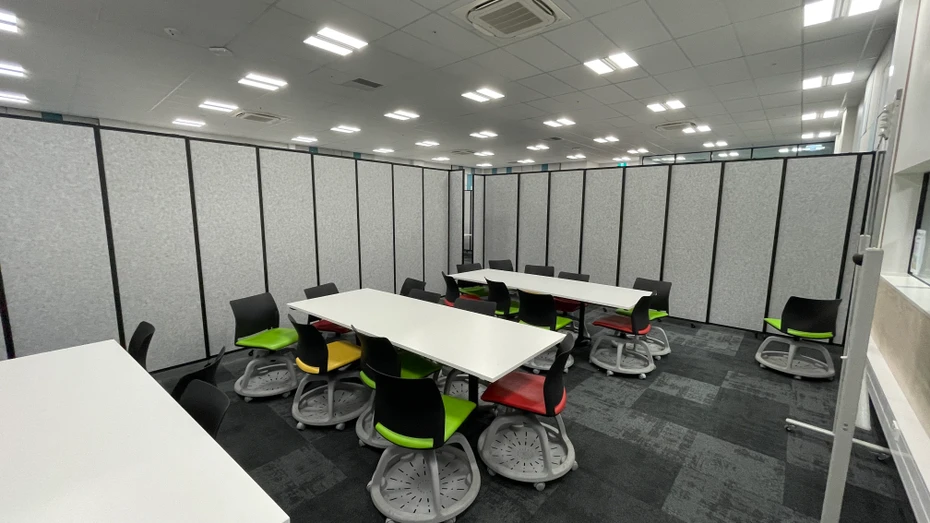
How to Divide an Open-Plan Classroom Without Building Walls
Short answer: You have three realistic options: permanent internal walls, glass sliding doors, or portable acoustic partitions. The first two options can cost hundreds of thousands and take years to schedule. Portable partitions cost a few thousand, need no consent or construction, and can be in the room this term.
Why so many New Zealand schools are dividing their open-plan spaces
In July 2025 the Government stopped building open-plan classrooms. Education Minister Erica Stanford said feedback from schools was that open-plan layouts were not meeting the needs of students, with problems around noise and managing behaviour, and that all new classrooms would be built to standard designs allowing flexibility. chrislynchmedia
That left hundreds of schools sitting in spaces built under the previous approach. The costs of undoing them are significant. Rangiora High School spent $1.5 million converting a 2017 open-plan building that holds 500 students back into single-cell rooms, citing noise, visual distraction and inconsistent temperatures. Shirley Boys' High School moved into an open-plan complex in 2019; an inquiry finishing in December 2023 concluded the spaces "should not be considered fit for purpose", with about 70% of year 13 students agreeing their education was negatively affected by outside distraction. odtpressreader
Government help now exists, but it is a queue. Funding of $31.3 million was announced to help schools install walls in open-plan classrooms, covering more than 150 schools in phase two, with the less complex projects expected to be finished in the summer of 2028/29. For a school with a class struggling right now, that is three years of terms away. 1news
What each option actually costs and takes
Permanent internal walls. The complete fix, and the most expensive and slowest. Rangiora's project ran to $1.5 million and was funded in thirds: the board, the Ministry, and the school's 10-year property plan. Expect design, consent, contractors and a disrupted term.
Glass sliding doors. The design the Ministry now favours for new builds. Good where the building's structure supports it, but it is still construction, still consented, and still scheduled.
Portable acoustic partitions. Freestanding panels that divide a space into teaching areas, absorb reflected sound, and cut the line of sight between groups. No consent, no builders, no downtime. They can be moved for assemblies or exams and reconfigured as your timetable changes, and they come out of the operations budget rather than a property programme.
Be clear about what a partition does and doesn't do
Honest answer, because it matters for the decision: a portable partition is not a wall. It will not deliver the sound blocking of a stud wall with insulation, and no supplier should tell you it does.
What it does do is reduce reverberation and absorb the noise that makes an open space exhausting, and remove the visual distraction that pulls students' attention out of their own class. In most classrooms, reflected noise and sightlines are the actual problem, not sound passing through a solid barrier. Schools that have trialled partitions typically report a usable teaching space immediately, then decide about permanent walls later with better information.
If you need measurable separation between two classes running different subjects at volume, budget for walls. If you need a teacher to hold a group's attention without shouting, partitions solve it this term.
What to look for in a classroom partition
- Acoustic absorption, not just a screen. Ask for the NRC rating of the panel surface. This tells you how much sound the panel absorbs. A good starting point would be an NRC of 0.6 or 60% absorption.
- Height that blocks sightlines. Seated students need roughly 1.5m; standing teachers and sightlines across a room need more.
- Safe, stable, movable. Castors that lock, a footprint that won't tip, and light enough for one adult to reconfigure.
- Finish that survives a school. Wipeable, scuff-resistant, and repairable panel by panel rather than replacing a whole unit.
- Lead time you can plan a term around. Versare partitions are made in our Mt Wellington factory and dispatch in about seven working days, with free freight nationwide.
How schools are paying for it
Because partitions are furniture rather than building work, they generally sit in the operations grant or a curriculum or property budget, and don't need to wait for a Ministry conversion project. Schools in the conversion queue often use them as an interim measure, then keep them afterwards for hall dividing, exams, parent evenings and breakout groups.
Frequently asked questions
Can you divide an open-plan classroom without building work?
Yes. Freestanding acoustic partitions divide a large space into defined teaching areas without consent, contractors or downtime. They're moved into place by staff, reconfigured as needed, and paid for from operational budgets rather than a property programme.
How much does it cost to divide an open-plan classroom?
Permanent conversions have run into the hundreds of thousands: Rangiora High School's project cost $1.5 million and Shirley Boys' High School budgeted $800,000. Portable acoustic partitions cost a few thousand dollars per teaching area, depending on the width you need to cover.
Do portable partitions actually reduce classroom noise?
They reduce reflected noise and remove visual distraction, which is what makes most open-plan rooms difficult to teach in. They do not block sound the way an insulated wall does. For most schools, absorbing reverberation and breaking sightlines is enough to make a space workable.
How long until we could have them in the room?
Versare partitions are made to order in Auckland and dispatch in about seven working days, with free freight nationwide. Most schools go from enquiry to a divided classroom inside a month, well within a single term.
We're in the Ministry's conversion programme. Should we still consider partitions?
Many schools do. Phase two projects are scheduled out to 2028/29, so partitions bridge the gap and stay useful afterwards for halls, exams and breakout spaces.
Get a layout and a price for your space
Send us the dimensions of the space, how many teaching areas you need, and when you need it by. We'll come back with a configuration and a price, usually within a business day.